

-
Rewarding Excellence
 Rewarding Excellence in Logistics and Supply Chain Management.LEARN MORE
 -

Encouraging Innovation
Encouraging Innovation in Logistics and Supply Chain.LEARN MORE -

Creating Awareness
Creating Awareness of the Logistics and Supply Chain Industry.LEARN MORE
Logistics Achiever Awards 2024

We are delighted to announce the return of the Logistics Achievers Awards, in collaboration with the Gordon Institute of Business Science (GIBS). A proudly Africa-based institution, GIBS is committed to serving, inspiring and advancing world-class business practices across the continent and beyond. We embrace a human-centric approach to business; striving to make business healthier and more sustainable through decisive leadership, long-term strategic intent, and the development of inclusive, equitable, diverse and climate-sensitive business environments.
GIBS is proud to be associated with this initiative that aims to redefine excellence and innovation in the logistics industry. The prestigious awards, celebrated as the premier recognition in the logistics industry in South Africa, will be presented at a gala event attended by top business executives and supply chain professionals from diverse sectors.
Logistics Achiever Awards Objectives
Recognise Excellence
Honor professionalism and excellence in logistics and supply chain management practices in Southern Africa.
Encourage Innovation
Inspire Organisations to evaluate and enhance their current logistics and supply chain management practices.
Create Awareness
Foster a greater understanding of the value of effective logistics and supply chain management.
Why Enter the Logistics Achiever Awards?

Industry Recognition
With over 33 years of honouring excellence, the LAA offers unparalleled recognition for outstanding achievements and innovations, laying a strong foundation for sustainable growth.
Industry Benchmark
Our judging panel comprises representatives from various professional institutes, vocational societies, and trade associations, ensuring a fair and balanced evaluation process.

Selection Criteria
Your case study is evaluated based on:
- Introduction of Company
- Definition of specific Problems / Challenges
- Analysis
- Solution
- Implementation
- Results achieved to date
- Learnings
- The team involved
- The Way Forward
Logistics Achiever Awards Rules
What can you enter submit to the Logistics Achiever Awards?
The goal of the Logistics Achiever Awards is to recognise professionalism and excellence in the effective application of strategic, tactical, and operational logistics and supply chain management principles, concepts, and practices.
If you have successfully completed a logistics or supply chain management initiative in your own organisation or in partnership with others and you feel that it has achieved a level of excellence that should be recognised by the industry and your peers, we encourage you to consider putting an entry forward into the 2024 Logistics Achiever Awards.
The competition rules are:
All Competing Organisations are required to submit an official competition entry, as called for in this document. Entries close on 31 May 2024.
Organisations can submit as many entries as they see fit, provided that each entry/project is independent of one another.
If the company wishing to enter is a supplier of a product or service, the ideal is to have it as a joint entry by the supplier and the client, as an entry by the end-user of the product /service will be required to support verification of the results. The exact nature of the entry relationship must be stated at the outset.
The Judging Panel may reject any entries that they deem unsuitable, irregular, improper or untested.
Organisations are required to be interviewed by nominated Judges, and make available to them, the site(s) in question, and information/records substantiating the declared improvement in logistics and supply chain management performance. All Judges will sign a confidentiality agreement with GIBS, and can, if required, sign a confidentiality agreement with the individual entering Organisations, provided such documents are available for signing at the time of their scheduled visit. Any and all potential conflicts of interest will be avoided wherever they are known to exist.
Due to the tight schedule of the judging process, Organisations are requested to make every effort to accommodate judge visits as soon as possible after they contact you.
Entries may be categorised at the discretion of the Judges to allow meaningful comparison with other entries in the same economic sector, company size or focus area.
It is our goal to share the successes of all winning projects with our supply chain community at large. Each project will be presented in the annual special Case Study Annual (subject to editorial review by the entering company) as well as presented to the industry as a video case study during the award function. This would require the co-operation and participation of the entrants to share relevant insights into the project on camera (also subject to editorial review by the entering company). Access to an operation may also be required for additional video footage.
The selection of the winners will be at the sole discretion of the Judges, and their decisions will be final. No correspondence will be entered into.
Please ensure that you have read, understood and accepted the competition rules. We will gladly answer any questions you may have regarding the rules or judging process.
We look forward to engaging with you on your entry into the Logistics Achiever Awards - you may place an entry into the awards through the link below. For any queries, please contact boxallb@gibs.co.za
JUDGING PROCESS
The Judging Panel has historically included nominated representatives of the various professional institutes, vocational societies and trade or industry associations involved in logistics and supply chain management in Southern Africa. Our judges are experienced veterans of the industry who bring their decades of experience to the judging process. Other industry representatives may be added to our judging panel from time to time to enrich the judging process.
Step One
By clicking on any of the "enter now" tabs, entrants can start the entry process and submit a brief overview of their project. This entry will be logged onto the LAA schedule to ensure they are kept informed of all activities relating to the competition. Please note that there is no entrance fee.
Step Two
On being accepted as a valid entry to the LAA, entrants will be requested to complete an expanded entry template, offering greater detail on your project. Based on the information supplied, the judges can at this stage assess the suitability of the entry.
Step Three
A member of the judging panel will then contact the entrant’s representative to arrange a site visit. On this visit, the entrant is expected to discuss and elaborate on the entry details, demonstrate what the company or organisation has undertaken with respect to the entry project, addressing the core issues, and answer any questions that the judges may feel are appropriate.
A visit typically takes between 2-4 hours depending on the nature of the entry.
It is important to note that the judges sign a confidentiality agreement with GIBS regarding all information supplied to them in respect of their judging role in this competition. As this is essentially a factfinding visit, no official feedback relating to the entry status in the competition will be provided at this point.
Step 4
In this final step, all short-listed entrants will be required to present the entry to the full panel of judges at GIBS. Ample notice will be provided on a date to present to the panel to prepare.
Timeframe Over a Year
- Information Sessions Webinars: April 2024
- Case Submission: Apr - May 2024
- Entries close - 31 May 2024
- Judge Reviews: June – August 2024
- Site Visits to Shortlisted Entrants: July
- Panel Presentations: August
- LAA Award Ceremony: October 17
- Winning Cases showcased in publications and webinar: November-January
Join us as we celebrate excellence and innovation in the logistics and supply chain industry!







GIBS Climate Awards
One of GIBS Strategic Pillars is Climate Leadership. In line with that, the award will recognise organisations' efforts in minimizing environmental impact of their supply chain processes.
The criteria for the Awards are:
- Organisations should demonstrate compliance with environmental regulations, both national and international.
- Organisations will need to illustrate success in minimising waste from the supply chain process and the overall adoption of ‘green’ practices across their supply chains.
- Organisations will need to demonstrate success in reducing their carbon footprint.
- Organisations will need to illustrate success in transforming the green agenda into a business opportunity that offers added value.
- Organisations should be proven to regularly take measures to improve their environmental performance, such as through the application of environmental criteria to assess and choose suppliers, transporters and other partners.
- The entrants will be judged on a submission of approximately 1 000 words, along with any supporting documentation the entrant company feels is necessary to support its case.
Dianne Holton Legacy Award
Di built the Logistics Achiever Awards (LAA) into a brand that recognised genuine, objectively measured supply chain achievement. She built the LAA because she was passionate about the industry and, by firing up industry leaders with that passion, there were very few who were able to resist when it came to supporting the LAA as sponsors, judges or organisers.
LAA represents not only an incredible legacy, with award certificates gracing the walls of the industry’s leaders and innovators, it is also the repository of many of the war stories that document South Africa’s eventful journey to success as a leader in logistics and supply chain management.
We hold the award to honour the pioneering spirit of the Di Holton by recognizing those who break new ground in their approach to supply chain challenges, creativity, and effective strategies that drive significant impact in the logistics field.
This award recognises innovation in supply chain specifically and awards the entrant with the highest score for innovation & leadership.
Previous Logistics Achiever Awards Winners
| Platinum | Gold | Silver |
|---|---|---|
|
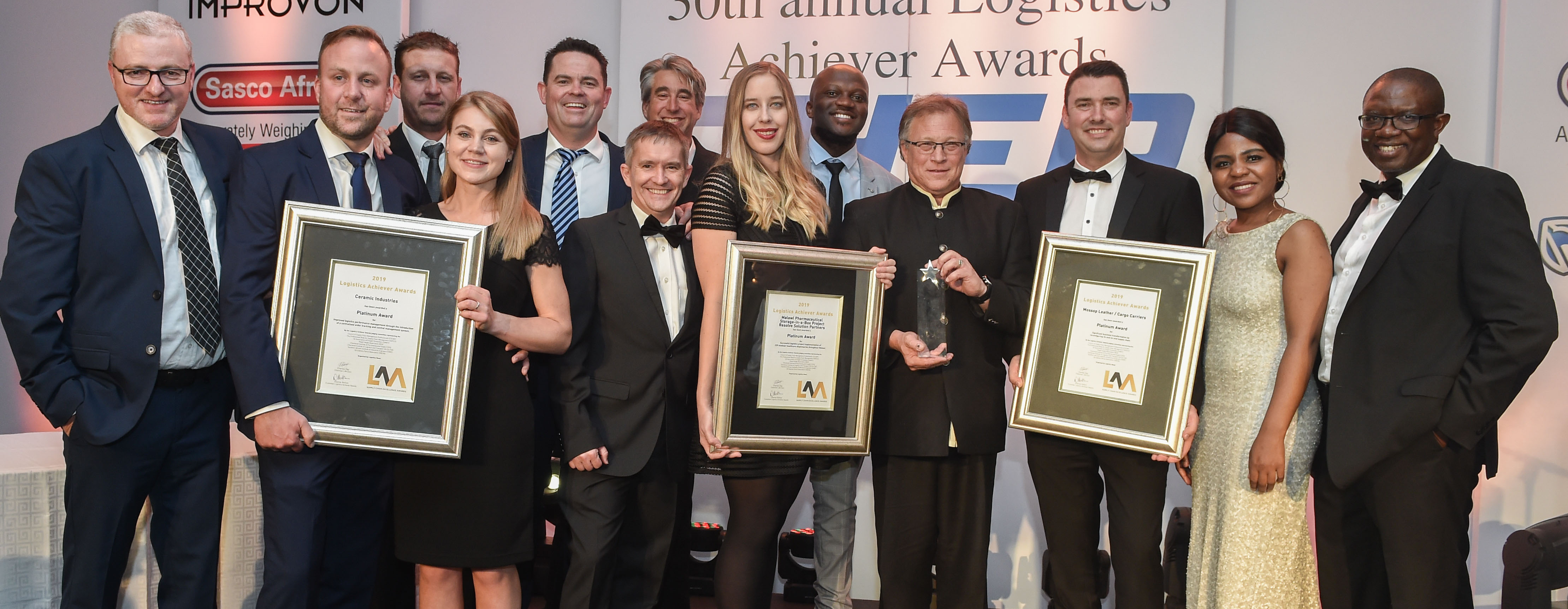
SA National Blood Services / Trenstar SA Volkswagen South Africa / InSync Solutions Fargo Courier / Dovetail Meadow Feeds / Barloworld Logistics ZZ2 Vodacom Transnet - Saldanha Transnet - Ceres Rail Ceramic Industries/ Inhance Massop Trading / Cargo Carriers Malawi Pharmaceuticals / Resolve Solution Partners |
Alpha Pharm Gauteng / Knapp Logistics SA DSV Clicks/Inhance DSV Raceway OneLogix Protea Chemicals RTT and the Foschini Group Sunstone Logistic Systems and ABInBev |
Cummins South Africa (Pty) LTD Supply Chain Eazi Access and Resolve Solution Partners Massmart/Trackmatic Pick n Pay Trenstar Transnet Checkout Stores/iWMS |
The Applications for 2024 LAA Awards Are Open. Submit your case by May 31, 2024
For any queries, please contact boxallb@gibs.co.za